
Bologna is a city that invites you to look closer—and arrive hungry. Known as La Dotta, La Grassa, and La Rossa—the Learned, the Fat, and the Red—it is shaped by the world’s oldest university, a celebrated culinary heritage, and the warm terracotta colors of its rooftops and historic buildings. Beneath miles of graceful porticoes, Bologna reveals medieval towers, lively piazzas, centuries-old academic traditions, hidden waterways, and tables filled with handmade pasta. These seven experiences will take you beyond the familiar images of Italy and into the history, flavors, and wonderfully authentic character that make Bologna such a rewarding city to discover.
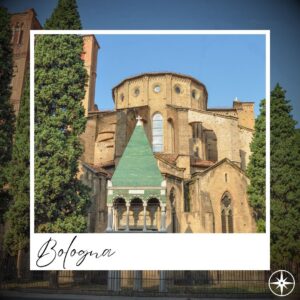
🇮🇹 7 Days of Bologna | Day 1: Welcome to Bologna
Welcome to Bologna—a city of medieval towers, endless porticoes, lively piazzas, and some of the most celebrated food in Italy.
Bologna is often described by three affectionate nicknames: La Dotta, La Grassa, and La Rossa—the Learned, the Fat, and the Red. Together, they tell the story of this fascinating and wonderfully authentic city.
La Dotta, the Learned, honors the University of Bologna, founded in 1088 and widely recognized as the oldest university in the Western world. Students have filled the city’s lecture halls, libraries, cafés, and streets for centuries, giving Bologna an intellectual energy that remains very much alive today.
La Grassa, the Fat, celebrates its extraordinary culinary heritage. Bologna is the birthplace of beloved specialties such as tortellini, mortadella, tagliatelle al ragù, and lasagne verdi. Food here is more than nourishment—it is tradition, family, craftsmanship, and an essential part of the city’s identity.
La Rossa, the Red, refers to the warm terracotta rooftops and brick buildings that color Bologna’s skyline. Some also associate the nickname with the city’s long history of progressive politics.
Connecting it all are miles of covered porticoes, creating graceful walkways beneath historic buildings. These distinctive arches offer shelter from the sun and rain while making Bologna one of Italy’s most enjoyable cities to explore on foot.
Bologna may not receive the same attention as Rome, Florence, or Venice—and that is part of its appeal. It feels vibrant, welcoming, and refreshingly lived-in.
Linda’s Travel Tip: Don’t experience Bologna only as a quick stop between Florence and Venice. Stay for at least two nights so you can explore its historic center, enjoy a leisurely food tour, and experience the city after the day-trippers have departed.
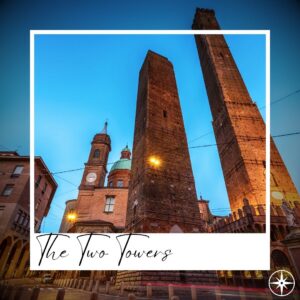
🇮🇹 7 Days of Bologna | Day 2: The Two Towers
Rising above Bologna’s terracotta rooftops, the Asinelli and Garisenda towers are among the city’s most recognizable symbols—and dramatic reminders of its medieval past.
During the 12th and 13th centuries, Bologna’s skyline was crowded with towers built by wealthy families. These impressive structures may have served defensive purposes, but they were also powerful displays of prestige, influence, and rivalry.
The taller Torre degli Asinelli reaches approximately 97 meters above the city. For centuries, visitors climbed nearly 500 wooden steps to enjoy sweeping views across Bologna and the surrounding hills.
Beside it stands the much shorter Torre Garisenda, which developed a significant lean soon after its construction. The tower was originally taller but was reduced to approximately 48 meters during the 14th century because of concerns about its stability.
Its dramatic tilt has fascinated writers and travelers for centuries. Dante Alighieri even mentioned the Garisenda in his Divine Comedy, comparing the leaning tower to the giant Antaeus bending toward him.
Together, the towers have survived wars, lightning strikes, fires, changing governments, and nearly nine centuries of city life. Today, the Garisenda is undergoing an extensive stabilization and restoration project designed to protect one of Bologna’s most treasured landmarks.
Linda’s Travel Tip: The Asinelli Tower and the area immediately surrounding the Garisenda remain closed while the restoration work continues. Travelers can still see the towers from several nearby streets, but routes and viewpoints may change as work progresses. Check the latest local information before visiting and never enter a restricted area for a photograph.
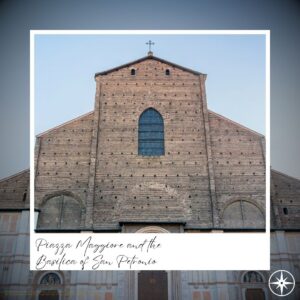
🇮🇹 7 Days of Bologna | Day 3: Piazza Maggiore and the Basilica of San Petronio
At at the heart of Bologna is Piazza Maggiore, a magnificent public square bordered by medieval palaces, elegant porticoes, and centuries of civic history.
The piazza began taking shape during the 13th century, when the city cleared existing buildings to create a central gathering place. Since then, it has hosted markets, public celebrations, political events, religious ceremonies, and the everyday rhythms of Bolognese life.
Dominating one side of the square is the Basilica of San Petronio, dedicated to Bologna’s patron saint. Construction began in 1390 with plans for an enormous church that would reflect the prosperity and independence of the city.
Its most recognizable feature is the unfinished façade. The lower section is covered in beautifully carved pink-and-white marble, while the upper portion remains exposed brick. Several ambitious designs were proposed over the centuries, but the façade was never completed—creating the distinctive appearance visitors see today.
Inside, the basilica feels vast and surprisingly understated. Its chapels hold important works of art, while a brass line set into the floor marks one of the world’s longest indoor meridians. Created by astronomer Giovanni Domenico Cassini in the 17th century, it uses a beam of sunlight entering through a small opening high in the wall to help measure the solar year.
The basilica also hosted a momentous event in 1530, when Pope Clement VII crowned Charles V as Holy Roman Emperor—the last imperial coronation performed by a pope.
Linda’s Travel Tip: San Petronio is not Bologna’s cathedral, despite its enormous size and prominent location; that distinction belongs to the Cathedral of San Pietro. Before leaving the piazza, visit the nearby Voltone del Podestà. Stand in one corner of the vaulted passage while someone whispers from the diagonally opposite corner—the unusual acoustics will carry your voices across the space.
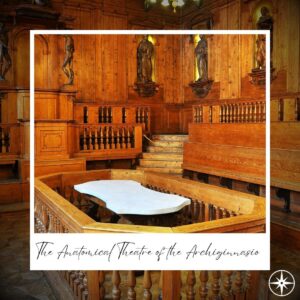
🇮🇹 7 Days of Bologna | Day 4: The Anatomical Theatre of the Archiginnasio
Hidden inside one of Bologna’s most historic buildings is an extraordinary wooden lecture hall where medical students once gathered to study the mysteries of the human body.
The Archiginnasio was constructed during the 16th century to bring the University of Bologna’s various schools together under one roof. It served as the university’s principal building until the early 19th century, and its corridors remain covered with thousands of colorful coats of arms belonging to students and professors from across Europe.
At the center of the complex is the Anatomical Theatre, built in 1637 and almost entirely lined with intricately carved wood. The room was designed for anatomy lessons and dissections, with tiered seating allowing students to observe as a professor taught from the central marble table.
Among its most striking features are two wooden figures known as the Spellati, or “Skinned Men.” Created by sculptor Ercole Lelli, the figures display the muscles of the human body while supporting the canopy above the professor’s chair.
Look upward and you’ll see Apollo, the god associated with medicine, surrounded by carved constellations. The design reflects a time when physicians believed the movement of the stars could influence human health.
The theatre visitors see today is also a remarkable story of restoration. Much of the room was destroyed during an air raid in 1944, but surviving fragments were carefully recovered and used to reconstruct it after World War II.
Linda’s Travel Tip: Don’t rush directly to the Anatomical Theatre. Take time to explore the Archiginnasio’s courtyard and decorated corridors, where the coats of arms reveal just how international the University of Bologna was centuries ago.
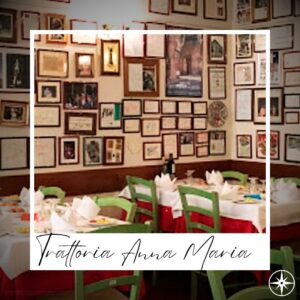
🇮🇹 7 Days of Bologna | Day 5: Trattoria Anna Maria
In a city affectionately known as La Grassa—“the Fat”—choosing just one restaurant to feature is no easy task. But Trattoria Anna Maria offers exactly what many travelers hope to find in Bologna: handmade pasta, time-honored recipes, and the comforting flavors of a traditional family kitchen.
Founded by Anna Maria Monari in 1985, the trattoria has spent decades preserving the culinary traditions she learned while growing up in the countryside surrounding Bologna. Inside, vintage photographs and memorabilia create a warm, unpretentious atmosphere that feels deeply connected to the city.
Fresh egg pasta is the star of the menu. Sheets of dough are rolled by hand and transformed into regional classics such as tortellini in broth, tortelloni filled with ricotta, lasagne verdi, and tagliatelle al ragù.
And here is an important lesson for visitors: the celebrated meat sauce we call “Bolognese” is traditionally served with tagliatelle—not spaghetti. The broad ribbons of egg pasta hold the rich, slowly cooked ragù far better than thin strands of spaghetti.
Tortellini in brodo offers another essential taste of Bologna. The tiny stuffed pasta is traditionally served in a flavorful broth, creating a dish that is simple in appearance but requires tremendous skill and patience to prepare properly.
A meal at Trattoria Anna Maria is about more than sampling pasta. It is an opportunity to experience Bologna’s culinary identity—one shaped by family recipes, carefully selected ingredients, and generations gathered around the table.
Linda’s Travel Tip: Reservations are highly recommended. Arrive hungry, order more than one pasta dish for the table, and share so you can experience several Bolognese specialties during the same meal.
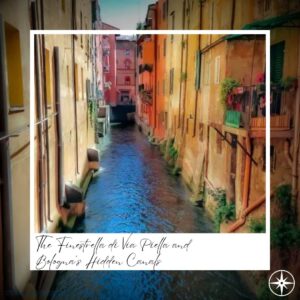
🇮🇹 7 Days of Bologna | Day 6: The Finestrella di Via Piella and Bologna’s Hidden Canals
Bologna may be known for its towers and porticoes, but beneath and between its historic streets flows another, often-overlooked part of the city’s story: a network of medieval canals.
One of the most charming glimpses can be found along Via Piella. Set into an ordinary wall is a small wooden window known as the Finestrella—the “Little Window.” Open it, and an unexpected scene appears: colorful buildings leaning over the Canale delle Moline, with water flowing quietly between them.
The view has earned this corner of Bologna the nickname Piccola Venezia, or “Little Venice.”
During the Middle Ages, Bologna’s canals played an essential role in the city’s growth. Water was redirected from the Reno and Savena rivers to power grain mills, transport goods, operate workshops, and support Bologna’s thriving silk industry.
By the late Middle Ages and Renaissance, the city had become an important European center for silk production. Water-powered machinery helped artisans create finely woven fabrics that were exported throughout Europe.
As Bologna modernized, many of its canals were covered by streets and buildings. The waterways did not disappear completely, however. Some continue to flow underground, while others occasionally emerge into view through hidden openings and quiet stretches between buildings.
Linda’s Travel Tip: The little window has become increasingly popular, so visit early in the morning for a quieter experience. After opening the Finestrella, cross to the other side of Via Piella, where you can see another open view of the canal without looking through the window. Water levels can vary throughout the year.
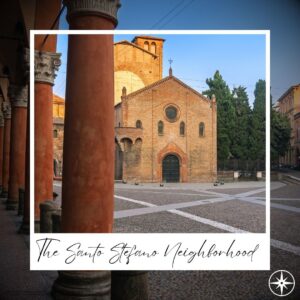
🇮🇹 7 Days of Bologna | Day 7: The Santo Stefano Neighborhood
Just beyond Bologna’s busiest central streets lies Santo Stefano, an elegant neighborhood filled with graceful porticoes, historic palaces, artisan shops, inviting cafés, and one of the city’s most atmospheric piazzas.
The neighborhood takes its name from the Basilica of Santo Stefano, an extraordinary complex often called Sette Chiese—the Seven Churches. Rather than a single church, it is a collection of interconnected sacred spaces, courtyards, chapels, and cloisters built and altered across many centuries.
According to tradition, Saint Petronius, Bologna’s patron saint, envisioned the complex as a symbolic recreation of sacred sites in Jerusalem. As you move through its shadowed passageways, each doorway reveals another layer of history.
The octagonal Church of the Holy Sepulchre forms the spiritual heart of the complex, while the quiet Courtyard of Pilate and medieval cloisters create a sense of stillness that feels far removed from the modern city outside. Although fewer than seven distinct churches remain today, the traditional name has endured.
Outside, Piazza Santo Stefano unfolds in a wide, triangular shape framed by brick palaces and long porticoes. There are no grand fountains or elaborate monuments at its center—just open space and beautifully preserved architecture. That simplicity gives the piazza its distinctive charm.
Continue along Via Santo Stefano and the neighborhood becomes even more inviting. Elegant residences, independent boutiques, small restaurants, and hidden courtyards make this an ideal area for an unhurried afternoon.
Linda’s Travel Tip: Visit the basilica earlier in the day, then return to Piazza Santo Stefano in the evening for aperitivo. The warm brick façades become especially beautiful in the late-afternoon light, and the piazza is a wonderful place to experience Bologna’s relaxed social atmosphere.
Bologna is a city best experienced slowly—beneath its sweeping porticoes, around tables filled with handmade pasta, and along streets where medieval history remains part of everyday life. From the famous Two Towers and the grand Piazza Maggiore to an extraordinary anatomical theatre, hidden canals, traditional Bolognese cuisine, and the atmospheric Santo Stefano neighborhood, each experience reveals another layer of the city’s distinctive character. Bologna may not demand attention in the same way as Italy’s most famous destinations, but that is precisely what makes it so rewarding. When you’re ready to discover Bologna for yourself, Linda’s Travel Hut, LLC can create a thoughtfully planned Italian journey filled with celebrated landmarks, authentic flavors, and unforgettable hidden treasures.
